Freshwater Pearl Necklace Price — Why $30 vs $300
Updated: Oct 24

Search "freshwater pearl necklace" and you'll find one for $30 and another, almost identical in the photo, for $300. Both say "real pearls." Both might be telling the truth.
I've been buying freshwater pearls by the strand and turning them into jewelry since 2020, so I see the inside of this price gap every time I place an order. Here's what actually sits between those two numbers, and how to tell what you're paying for.
Real Doesn't Always Mean Expensive
A cheap pearl necklace isn't automatically a fake one. Almost every real pearl sold today is cultured, meaning a pearl farmer started it, and freshwater pearls are cultured in enormous numbers.
One freshwater mussel can grow many pearls at a time. A saltwater oyster usually grows one or two. That difference in volume is the main reason a real freshwater strand can cost less than a nice dinner.
So the useful question isn't "real or fake." It's "which real pearls, and how good are they." (If you're still on the first question, my post on how to tell if pearls are real walks through it.)
What Makes One Pearl More Valuable Than Another?
Once you know the pearls are real, six things decide most of the price. Luster matters most, and it's the one photos hide best.
Luster. How sharply the surface reflects light. A good pearl shows a crisp reflection, almost like a tiny mirror. A low-luster pearl looks chalky or flat, and no setting can fix that.
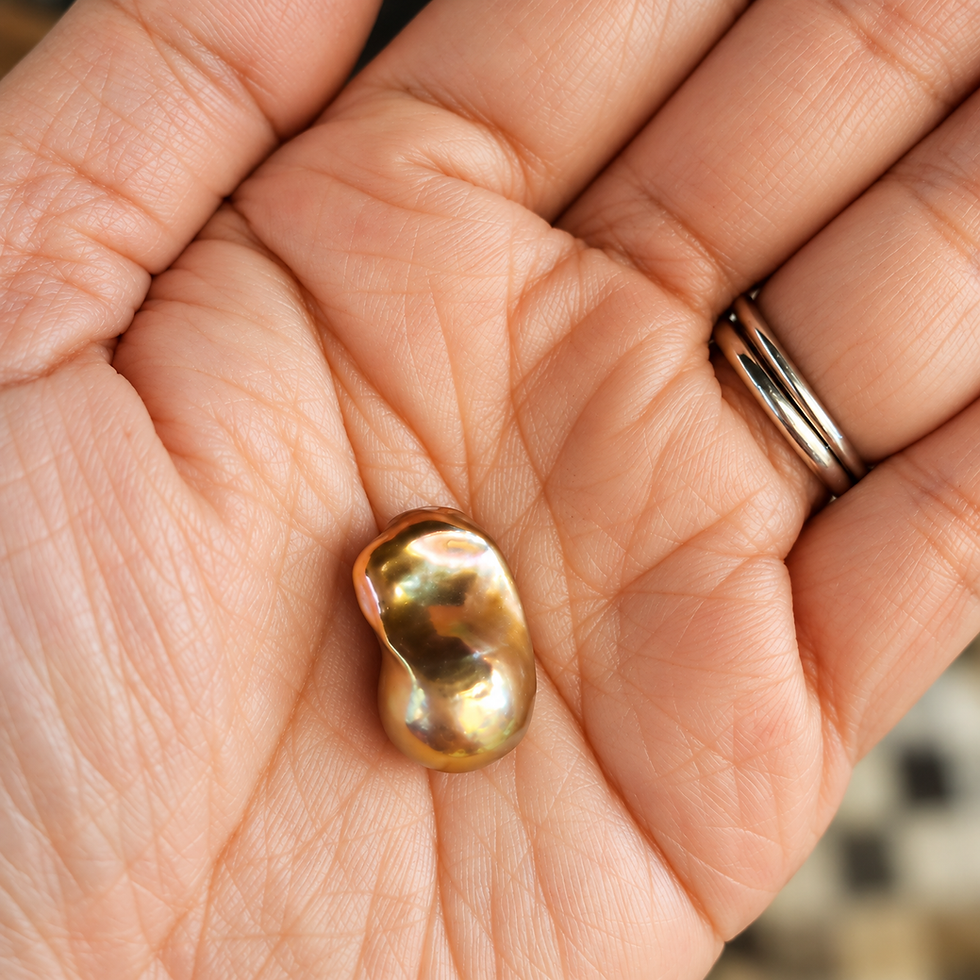
Golden Baroque Pearl in Hand Surface. Small spots, dimples, or ripples. Nearly every pearl has a few. What matters is whether you notice them when it's on your neck, not under a magnifying glass.
Size. Bigger costs more, and the price climbs faster than the millimeters do.
Shape. Perfectly round is the rarest shape in freshwater pearls, so it's priced highest.
Color. Freshwater pearls grow naturally in white, cream, pink, peach, and lavender. Most white freshwater pearls are also bleached and polished, which is standard practice. Brighter or darker shades are usually dyed or irradiated. Irradiated color is generally stable; dye can fade over years of sun and wear. Neither is a problem as long as the seller tells you.
Matching. On a strand, every pearl has to sit well next to its neighbors in size, tone, and luster. Sorting for that takes time, and time is cost.
This is where a lot of the hidden work lives. Not every pearl on a strand makes it into a finished piece, and from one order of about ten strands I usually end up with five to ten pieces.
I’d show you a low-luster pearl next to a good one, but I don’t have any to photograph. Pearls with poor luster never make it to my workbench. I throw them out.
Perfectly Round Isn't Always Better
Round pearls cost more because they're rarer, not because they're more beautiful. The grading system rewards rarity. Your eye doesn't have to.
Baroque pearls, the irregular ones, are graded lower on shape. That works in your favor. For the same money, you can often get a larger pearl with stronger luster than you'd get in a round one.
They also look less formal. A round strand can read as "special occasion." A baroque pearl on a fine chain goes with a sweater and jeans. I wrote more about why I love baroque pearls, but the short version is that every one is a different shape, so no two pieces come out the same.
Beyond the Pearls Themselves
Two necklaces can use the same pearls and still be worth very different amounts. The rest of the price is in the metal, the design, and the hands that made it.
The metal. Much inexpensive jewelry uses a thin electroplated layer over brass or copper. It looks fine on day one and starts to wear through with daily use. I use 18K PVD titanium steel for the parts that carry weight, like chains and clasps. PVD is applied in a vacuum chamber and bonds to the steel far more durably than standard plating. I didn’t just take the supplier’s word for it: I tested PVD findings myself and wrote up the results in my PVD test post. They showed very little fading.
The design. Someone decided how long the chain is, where the pearl sits, and how it moves when you turn your head. Good design is mostly invisible. You just notice that a piece feels right and you keep reaching for it.
The making. Every piece I sell is made by hand, by me, in Pittsburgh. Most are made to order. That's slower than a factory line, and it's part of what you pay for.
How it wears. Weight, comfort, whether the clasp is easy to close by yourself. These don't show up in a listing photo, but they decide whether a piece gets worn or sits in a drawer.
How to Shop With Confidence
You can't hold a pearl online, but a good listing tells you most of what you'd learn in person. Here's what I'd look for.
The pearl type is named. Freshwater, Akoya, South Sea. "Genuine pearl" alone tells you very little.
Size is given in millimeters. "Dainty" and "statement" aren't measurements.
Treatments are disclosed. If a color looks unusually vivid or uniform, ask whether it's dyed.
The metal is named exactly. "Gold-tone" or "gold color" could mean almost anything underneath.
There's a photo on a person, not just on a white background, so you can judge scale.
The seller is honest about variation. Pearls differ from batch to batch. A seller who promises an exact color match is promising something nature doesn't.
Grades are explained, not just stated. There's no universal grading standard for freshwater pearls. "AAA" means whatever that seller decided it means.
You know who made it and what happens if it's not right. A clear return policy says a lot about how confident a seller is.
Where My Pieces Fit
Mooncord Studio sits deliberately in the middle of that $30-to-$300 range. I'm not competing with the cheapest strand online, and I'm not selling saltwater pearls at fine-jewelry prices.
What I focus on is the part I can control: choosing pearls with good luster, especially baroque ones with real character, pairing them with 18K PVD titanium steel that holds up to daily wear, and making each piece by hand. Some pieces are made for an ordinary Tuesday. Others, like my floral designs, are for the days you’re dressing up for something.
If you'd like to see how all of this looks in actual pieces, you're welcome to browse the collections.

Comments